Wednesday, 27 June 2012

22 year-old Nigerian breaks academic record at John Hopkins University


22 year-old Nigerian breaks academic record at John Hopkins University

22 year-old Emmanuel Ohuabunwa has emerged as the best graduating student in the John Hopkins University, USA with a grade point of 3.98 out of 4.0 in Neurosciences.
Ohuabunwa who hails from Abia State, has been able to make the nation proud and with his efforts has won himself a scholarship to Yale University to get a degree in Medicine.
He has also become a member of Phi Beta Kappa Society, a prestigious honor group that features membership of 17 US Presidents, 37 US Supreme Court Justices, and 136 Nobel Prize winners.
The Phi Beta Kappa Society is an academic honour society. Its mission is to “celebrate and advocate excellence in the liberal arts and sciences” and induct “the most outstanding students of arts and sciences at America’s leading colleges and universities.”
Speaking about how he moved to the US, Ohuabunwa said “my parents moved the whole family when I was 13 years old. I was about to begin SS1 at Air Force, Ibadan. When I got to the US, I was enrolled with my age mates, which meant at 13, I was in middle school.
“I went to Fondren Middle School, which was in the middle of the ghetto. That was one of the darkest years for me because I encountered a lot of peer pressure. Some of the students, ignorant about Africa, bullied me and called me names such as ‘African booty scratcher’ because to them, Africans were dirty and scratched their butts all the time.
“Some asked me if I lived in mud huts and ate faeces for breakfast.
“I remember one day, when I was walking to the school bus, a boy came from behind and punched me in the face, called me an African and walked away. It took everything in me not to retaliate. I knew that God had put me in the U.S for a purpose and it did not involve fighting or selling drugs or doing the wrong things.
“My experience during that year gave me a thick skin. I learned to stand for what I thought was right even when the opposition seemed insurmountable. I also learned to look at the positive in all situations. Even though these kids were bullying me, I was still gaining an opportunity to school in America and nothing would stop me from making the best of this opportunity.
“I knew I wanted to go to the best school in the US. I had heard that Johns Hopkins Hospital had been ranked the number one hospital in the US for the past 21 years and I wanted to be in that environment.’’
Worried that his parents might not be able to sponsor him to the university, Ohuabunwa purposed to work very hard. He did and when the result of the PSAT came, he performed so well that he won the National Achievement Scholar.
By virtue of this award, he received certificates of recognition from various organisations including senators from the Congress of both Texas and the US. He also received scholarship from the University of Houston; Rice University, Texas A&M Honors College and many more.
He had also won the Principal’s Award during the annual awards ceremony at DeBakey High School.
“I studied Neuroscience, because I was fascinated with the brain, its control of our behaviours and how various diseases such as Alzheimer’s disease, lead to a decline in its activity. I also minored in Psychology because I wanted to understand disorders in the psyche. What causes bipolar disorders or schizophrenia.
I did not just want to label them as crazy but to understand what causes these conditions and how we can treat them,’’ he explained.
But what does he consider to be the missing links in the education sector of Nigeria when compared with that on offer in US, Ohuabunwa said unpredictable academic calendar, corruption, examination malpractice and inadequate funding were some of the problems confronting his home country’s university sector. These, he said, were absent in the US.

Is Cristiano Ronaldo the key to halting Spain's Euro 2012 progress? With the Real Madrid forward in devastating form for Paulo Bento's men, Phil Kitromilides is backing goals in tonight's first semi-final in Donetsk


Is Cristiano Ronaldo the key to halting Spain's Euro 2012 progress?

With the Real Madrid forward in devastating form for Paulo Bento's men, Phil Kitromilides is backing goals in tonight's first semi-final in DonetskSpain Euro 2012

ok
This Iberian derby has traditionally been a close encounter, with five of the last nine meetings between the sides ending in a draw.

Though it has been billed as Cristiano Ronaldo versus Spain, partly due to the Real Madrid forward's recent stunning form in the competition, the Portuguese will be confident of getting one over on their neighbours, having triumphed 4-0 the last time they met back in 2010.

Court stops FG from renaming UNILAG


Court stops FG from renaming UNILAG

SHARE THIS
A Federal High Court in Lagos on Monday granted an interim order restraining the Federal Government from renaming the University of Lagos.
The order was granted by Justice Stephen Adah, who was ruling in the suits brought against the May 29, 2012 renaming of the institution by the students and alumni of the University of Lagos.
The court, however, advised the litigants to harmonise the suits into one and adjourned further hearing till July 4.
The defendants in the suits are UNILAG, the UNILAG Governing Council, the UNILAG Senate, the Attorney-General of the Federation and the National Assembly.
President Goodluck Jonathan had last month renamed the University of Lagos after the late businessman and acclaimed winner of the June 12, 1993 presidential election, MKO Abiola.
The renaming of the institution as Moshood Abiola University was greeted by protest from the students and staff of the school. Others criticized the president for not following due process in renaming UNILAG. They insisted that the president should have consulted with the National Assembly before making the pronounciation on democracy.
President Jonathan on Sunday during a presidential media chat with selected journalist said that he did not breach the consititution of Nigeria in renaming the University of Lagos. He said the renaming the insitution is similar to the process the president can  declare state of emergency before subjecting the matter before the National Assembly.
He supported his arguement by saying that he just signed the act establishing the University of Uyo, a university that according to him have being producing Phd graduates.

New News: Obinna Metu is Nigeria’s fastest man

New News: Obinna Metu is Nigeria’s fastest man: Obinna Metu, on Wednesday at the U.J Eusene Stadium in Calabar emerged as Nigeria’s fastest man as he conveniently won the 100m event in a...

Obinna Metu is Nigeria’s fastest man


Obinna Metu, on Wednesday at the U.J Eusene Stadium in Calabar emerged as Nigeria’s fastest man as he conveniently won the 100m event in a time of 10.11secs seconds.
Obinna told journalists in Calabar that it was just a tip of what to expect from him at the London Olympics as he is now back in his full strides.
The 10.11secs time recorded by Metu is his personal best.
“I am speechless, many things have been said about me but I thank God I have proved them wrong today. My training in Jamaica and Atlanta is paying off already” he said.
“Though this is my personal best, I believe I can still run 9 seconds, I will remain focus and continue to work harder” he assured.
Last year’s champion Ogho-Oghene Egwero finished second in a time of 10.19 Stanley while US based Stanley Azie 10.32seconds.
Not surprised
National athletics coach, Innocent Egbunike, who was highly impressed, said after the race that Metu’s victory was a result of hard work and focus.
“There are times he would nearly pass out during training session but he remained focus and kept working harder. I am not surprised he won here today,” Coach Egbunike said.
Dethroned champion, Egwero said he was not moved by his defeat as he knows within him that he will surprise all at a bigger stage. He said the race was not a difficult one and that he would bounce back.
The 100m champion, Metu, has also qualified for the finals of the 200m event and looks good to complete a double on Thursday.

Uganda to ban NGOs accused of promoting gay rights


Uganda said on Wednesday it was banning 38 non-governmental organisations it accuses of promoting homosexuality and recruiting children.
Homosexuality is illegal in Uganda, along with more than 30 other countries in Africa, and activists say few Africans are openly gay, fearing imprisonment, violence and losing their jobs.
Ethics Minister Simon Lokodo told Reuters the organisations being targeted were receiving support from abroad for Uganda’s homosexuals and accused gays and lesbians of “recruiting” young children in the country into homosexuality.
“The NGOs are channels through which monies are channelled to (homosexuals) to recruit,” the minister, a former Catholic priest, said.
He did not name which organisations were on the list.
A bill calling for harsh penalties against homosexuals and outlawing the “promotion” of homosexuality, including providing financial support to gays and lesbians, is pending in the east African country’s parliament.
A previous bill called for the death penalty for repeat offenders, although the new version is expected to drop this clause, as well as calls for life imprisonment, after international condemnation of the proposal and threats to cut off aid.
Lokodo said the local and international non governmental organisations would be de-registered for promoting homosexuality.
“I have got a record of meetings that they have held to empower, enhance and recruit (homosexuals),” Lokodo said.
On Monday, he ordered the break up of a gay rights conference being held at a hotel just outside the capital Kampala.
Police officers sealed off the venue for several hours, detaining gay activists from around the region.
“They claimed they (were) investigating a security threat,” Pepe Julian Onziema, an activist with Sexual Minorities Uganda who attended the conference. “(The minister) is just trying to intimidate us.”
Around 15 activists from Uganda, Rwanda, Kenya and Tanzania were questioned and later released without charge.
“They were questioned on what exactly they were up to and the assembly they were involved in,” Kampala Metropolitan police spokesman Idi Senkumbi said.
Mohammad Ndifuna, the director of Human Rights Network Uganda, one of the organisations to be banned, said the minister’s threat was part of a larger attack on civil society in Uganda.
“We know that they have been all kinds of threats coming towards the (NGO) sector for different reasons,” said Ndifuna.
In May, Uganda threatened to de-register the British charity Oxfam over accusations of government involvement in violent land grabs in the country.

Antonis Samaras sworn in as new Greece Prime Minister


Antonis Samaras, the leader of the New Democracy party, which won Sunday’s election, has been sworn in as the country’s new Prime Minister.
The ceremony came shortly after he agreed a coalition government with the Socialists (Pasok) and the smaller leftist party, the Democratic Left.
Mr Samaras took the oath at a Greek Orthodox ceremony in Athens.
Afterwards he pledged his government would “do whatever we can for the people to come out of this crisis”.
“Tomorrow I will ask for the new government to be formed – [we will] work hard so we can give hope to our people,” Mr Samaras said.
The coalition deal follows weeks of uncertainty, after parties failed to agree a government on the results of an election on 6 May.
Syriza – the party which came second in Sunday’s poll – will be a defiant voice of opposition, correspondents say.

Court orders arrest of Pakistan’s Prime Minister nominee

A judge in Pakistan has ordered the arrest of President Asif Ali Zardari’s preferred candidate for prime minister, just a Makhdoom Shahabuddin’s arrest warrant is linked to imports of an illegal drug while he was health minister.
Parliament is due to vote on a new PM on Friday to replace Yousuf Raza Gilani, who the Supreme Court disqualified because of a contempt conviction. At the time, a senior aide to Gilani said only parliament could dismiss the prime minister, raising the possibility of a confrontation between court and government, but by nominating a new man the president has accepted the ruling and backed away from a fight.
It is not clear if the arrest warrant will derail Mr Shahabuddin’s nomination.
Pakistan’s president had nominated the ruling party veteran and former textiles minister Makhdoom Shahabuddin to replace the ousted prime minister, in an apparent bid for continuity ahead of elections due early next year.
Shahabuddin is expected to file his nomination papers on Thursday. The ruling coalition has a comfortable majority in parliament, which meets on Friday in an extraordinary session to elect a new prime minister.
Shahabuddin will face mounting public frustrations over a staggering range of problems, and a Supreme Court chief justice who prides himself on standing up to Pakistan’s most powerful players.
Gilani’s removal is likely to heat up the Pakistani political arena, where the civilian leadership, the powerful military and the Supreme Court square off against each other at the expense of a public longing for stability and a stronger economy.
Pakistan’s relations with the United States, which provides it with billions of dollars in aid, are at their lowest point in years.
Taliban militants still pose a major security threat, despite numerous army crackdowns. The economy is struggling and analysts predict Pakistan will again have to turn to the International Monetary Fund to keep it afloat.
Chronic power cuts, which triggered violent protests this week, show no signs of easing.
Shahabuddin, who enjoys smooth ties with coalition partners, was seen as a safe bet for the ruling Pakistan People’s Party, which is gearing up for a general election due early next year.
But the former deputy finance minister will likely face the same pressures as did Gilani from Supreme Court Chief Justice Iftikhar Chaudhry to reopen old corruption cases against Zardari.
Thousands of corruption cases were thrown out in 2007 by an amnesty law passed under former military president Pervez Musharraf, paving the way for a return to civilian rule.
Two years later, the Supreme Court ruled that agreement illegal, and ordered the re-opening of money laundering cases against Zardari that involved Swiss bank accounts.
Gilani and his government refused to obey the court’s order to write to Swiss authorities asking them to look again at those cases, arguing that Zardari had immunity as the head of state.
The United States is hoping for stability in Pakistan so that Islamabad can engage Washington and work to improve ties damaged by a series of events, most recently a NATO cross-border raid in November which killed 24 Pakistani soldiers.
Pakistan closed supply routes to NATO forces in Afghanistan to protest against the attack, and negotiations on re-opening the lines are deadlocked.day after he was nominated.

Nana Addo Speaks On Alleged Kimathi And Nana Dokua Wedding Story

                                                              Nana Akufo Addo and wife, Becky with thier two daughters

London's Big Ben to be renamed


Big Ben, parliament's famous clock tower, is to be renamed Elizabeth Tower in honour of the queen's diamond jubilee, officials announced on June 26.

Duke and Duchess of Cambridge


Prince William and Catherine NOTTINGHAM, ENGLAND - JUNE 13: Catherine, Duchess of Cambridge curtsies as her and her husband Prince William, Duke of Cambridge bid farewell to Queen Elizabeth II after visiting Vernon Park during a Diamond Jubilee visit to Nottingham on June 13, 2012 in Nottingham, England.Middleton, the Duke and Duchess of Cambridge.

Queen Elizabeth visits Northern Ireland

Britain's Queen Elizabeth II waves to the public as she arrives for a Service of Thanksgiving in Saint Macartin's Cathedral in Enniskillen, Northern Ireland, Tuesday, June 26, 2012. The Queen and the Duke of Edinburgh arrived in Northern Ireland for a two day visit to mark the Queen's Diamond Jubilee. (AP Photo/Peter Morrison)

Queen Elizabeth II prayed with Catholic and Protestant leaders from across Northern Ireland as this long-divided land demonstrated its rising faith in a shared future — and braced for a peacemaking milestone that has been a quarter-century in the making.

Ibadan electrocution: PHCN staff flee over youths’ threat


Staff of the Power Holding Company of Nigeria (PHCN) on Tuesday fled their office in the Apata area of Ibadan, Oyo state, following the death of seven people, including a pregnant woman, electrocuted to death by a high tension cable that snapped.
A local newspaper reports that the action was carried out to avoid being attacked by angry youths who thought the tragedy could have been averted if the officials had heeded their earlier appeals.
The offices were firmly locked on Tuesday, a day after, despite the fact that the security was beefed up at the office of the company due to a rumour that youths in the area were planning to attack PHCN staff.
Meanwhile, some residents in the area have called on the company to pay compensation to the families of the victims.
One of the residents, Alhaji Alamu said that the company should not only pay compensation to the families of the victims but also repair the snapped cable.
Also, the Vice Chairman, Senate Committee on National Planning, Economic Affairs and Poverty Alleviation, Olufemi Lanlehin promised to intensify campaigns across the state to prevent possible re-occurrence.
“The last Monday electrocution of some innocent citizens including an unborn baby marked yet another disaster which obviously left the rest of the citizenry sad and disturbed.
“In as much as one could not call it a worthy sacrifice in the life of a people who desire a new order in the manner which a country protects her own citizens, we pray God Almighty to grant the dead eternal peace.” Senator Lanlehin regretted.

Seventy dead, 200,000 stranded in Bangladesh floods


DHAKA (Reuters) - Days of rain in Bangladesh, some of the heaviest in years, have set off flash floods and landslides, killing at least 70 people and stranding about 200,000, police and officials said on Wednesday.
Low-lying and densely populated Bangladesh is battered by torrential downpours during the wet season, which began in the past few weeks.
At least 15 people were killed in and around the southeastern port city of Chittagong, while 30 died in Bandarban in an area known as the Chittagong Hill Tracts.
"Several more people are feared trapped in hillside homes buried under heaps of mud. Rescue operations are continuing," Chittagong Deputy Commissioner Faiz Ahmed said.
A further 24 died in the coastal district of Cox's Bazar near the Myanmar border, officials and police said.
Most of the deaths were caused by landslides, others by wall collapses, lightning strikes and surges of water. Army, police and fire brigade personnel were helping in rescue efforts.
In Sylhet, a rice and tea growing area in the northeast, houses stood up to three feet (one meter) under water, with residents perched on boats or scrambling to high ground. Three children were reported killed.
Flooding also hit districts northwest of the capital.
Five days of rain had beset wide areas near the border with Myanmar and India, with the weather office recording 463 mm (18.2 inches) in Chittagong over the past 24 hours.
"We are having the worst rainfall in many years," said Jainul Bari, district commissioner for Cox's Bazar.
Weather officials said more heavy rain was expected in the next few days.
Disaster control officials said about 150,000 people had been marooned by the floods in the southeast while 50,000 were stranded in Sylhet.
Hundreds of homes have been washed away, while authorities moved hundreds of families from shanty housing and told others to leave quickly.
Agriculture officials said it was too early to estimate crop damage. "In flash floods, water recedes soon after the rain stops, So we don't anticipate any major damage to rice and other crops," one official said.
Most road and rail links between Chittagong and the rest of the country were suspended late on Tuesday, while Chittagong airport was closed after water inundated part of the runway.
(Additional reporting by Ruma Paul, Nurul Islam in COX'S BAZAR and Raju Ahmed in SYLHET; Editing by Ron Popesi)

Monday, 25 June 2012

Euro 2012: Spain face tough task against Ronaldo's Portugal

Gniewino (Poland): Spanish players haven't altered their playing style to win recent titles, and they won't start now just because it's coming up against Cristiano Ronaldo.
Portugal will be counting on Ronaldo in Wednesday's European Championship semifinal against the defending champions, a second Iberian derby in as many tournaments after Spain beat their neighbours on their way to a World Cup triumph in 2010.
A total of eight Real Madrid players are spread across the Iberian rivals, making the teams privy to a fair degree of inside knowledge about each other.
Even so, the title holders made it clear on Monday they are not preparing any major changes just to take account of Ronaldo.
"We've got nothing planned, we'll play the same way regardless of the rival," said Spain midfielder Xabi Alonso, who was involved in many of Ronaldo's 60 goals for Real last season. "We can make small adjustments sure, play him close and keep him from finding space, but playing as a team is the best way to stop any player."
Ronaldo has finally found his club form with Portugal at Euro 2012, scoring three goals in successive victories over the Netherlands and the Czech Republic.
Two years after Spain beat Portugal 1-0 in the second round of the World Cup, Wednesday's game in Donetsk, Ukraine, certainly has the feel of a Spanish league rivalry.
Spain's passing and possession game mirrors that of Barcelona, while Portugal's counterattacks are more akin to Real Madrid's playing style under its Portuguese coach, Jose Mourinho.
However, Spain's players weren't susceptible to generalisations going into what will probably be their most difficult match since an opening 1-1 draw with fellow semifinalist Italy at the group stage.
"Portugal use a different system to Real Madrid, but it is true that one of their strongest points is the counterattack," forward Cesc Fabregas said on Monday. "And they're also a team with capabilities of possession through the likes of (Joan) Moutinho and (Raul) Meireles. If I was the coach and I had the punch of Cristiano Ronaldo and Nani on the wings, I'd also play that way."
Fabregas is enjoying his most prominent tournament yet with Spain, where he has normally been stuck on the substitutes bench behind Xavi Hernandez. But striker David Villa's absence due to injury has forced coach Vicente del Bosque to change his formation and Fabregas was the perfect candidate for the roving center forward spot that he sometimes occupies at Barcelona.
Though Portugal has Ronaldo, don't call Fabregas Spain's answer to Lionel Messi of Barcelona.
"I'll never compare myself to Messi, that would be a joke," said Fabregas, who has scored two goals, at the team's training base in northern Poland. "I don't think we should even mention Messi's name in this case since he's not here, and he's a very different player to me. He's the best player in the history of football. I'm enjoying this role and the liberty it gives me, I just try to do what the coach asks of me."
Spain's players said the death of former Liverpool and Real Betis player Miki Roque from cancer on Sunday had provided an extra inspiration for retaining their trophy, especially as it comes shortly after the death of Spanish coach Manolo Preciado.
"There were already many reasons to win this European Championship and to lose two people who were such a part of Spanish football provides further motivation," Fabregas said.
Alonso said the players were recovering well following Saturday's 2-0 quarterfinal victory over France at Donetsk's Donbass Arena, where they play Portugal with 48 hours less recuperation time than their opponents.
"That can't be an excuse, it's something we just have to deal with," Alonso said.

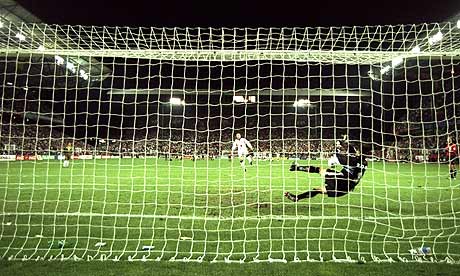
Euro 2012: There is no worse feeling than losing in a penalty shootout


England's David Batty fails to beat Carlos Roa in the 1998 World Cup shootout at St Etienne. Argentina won it 4-3 after a 2-2 draw. Photograph: Ross Kinnaird/Allsport
In the moments after England's elimination from Euro 2012 I was feeling so many emotions, not just because of the familiar sense of disappointment as our interest in another major competition came to an end but because of the way it happened. My mind went back to the 1998 World Cup, when I was in the team who got knocked out on penalties by Argentina and I remembered what I went through then, in many ways some of the hardest times of my career.

What I remember was the sense of loss that I felt after the match. During the game you're thinking only about winning and what you need to do to achieve it, and then suddenly you've lost in the most brutal way possible. Afterwards it's hard to comprehend what has happened. But the strange thing is that for all the grief, there's also a sense of relief that it's all over. There's so much pressure involved in a major competition and it's ratcheted up over the course of a tight match until you're almost ready to explode, so when it ends there's a sort of collective sigh. You're physically exhausted, of course, but emotionally exhausted as well. Now, at last you know it's finished.

You shouldn't underestimate how much of an impact the tournament environment has on the players. It is so intense. You may work every day with your club-mates but you will never spend that sort of time together. Away from your loved ones for several weeks, the squad become your family and you can form some very strong bonds. Then when you're beaten you get a few hours to pack your things before you fly home – and that family is gone.

After the Argentina match we flew back to our base and stayed up most of the night, had a few drinks and talked about the game and our performance. We had a couple of hours' sleep before we were put on a plane back to England and suddenly we were on our own. I'm sure my real family found me distracted for a while. I was aware that I needed to make a big effort to leave the World Cup behind. I thought I should get as far away from football as possible, so I booked us a really nice holiday and we had a lovely couple of weeks. It gave me a chance to recalibrate my mindset.

I'm sure whenever an England match goes to penalties the players are thinking: 'We've had no luck in the past but this is my time to do something about it.' That is strongly positive but the very fact that they are thinking about previous failures alters the frame of mind. Somehow, there is a weight on the shoulders. But the shootout started well for us against Italy, at least until Andrea Pirlo stepped up. He was the difference between the teams all night, and showed how much England need a technician who can control the tempo and the pattern of a game.

But if England had somehow survived despite his superiority in open play, what he did in the shootout destroyed us. There was so much self-belief in his penalty, so much confidence, and that will have filtered through to his team-mates. At the same time some of England's players, particularly Joe Hart – who had to watch the ball floating over his shoulder – would have found it demoralising. You've got to admire Pirlo's bravado but England's players probably felt that he had been humiliating and disrespectful. They must have been tempted to go straight over and give him a slap. Following that was very difficult and we couldn't – we didn't score another penalty.

I'm sure the players will be haunted by the key situations they were involved in – 'what if I'd taken that chance, what if I'd dived the other way, what if I'd scored my penalty'. There will be a lot of reflection and they should feel a sense of satisfaction. They came into the tournament with relatively low expectations and they've exceeded them.

None of those players put in a bad performance. England might not have been as productive or as creative as most supporters would like them to be but we have been effective, we have been incredibly disciplined and the team spirit created has been phenomenal. The challenge now is to build on it. Euro 2012 might have had a depressing ending but I hope we will one day look back on it as an exciting beginning.

Thousands of PDP, ANPP members defect to CPC


More than 5,542 members of the PDP and ANPP  in Karu Local Government Area  of Nasarawa have defected to the Congress for Progressive Change (CPC).
The defectors were received at the CPC's office in Gwunduma, Karshi Development Area by Gov. Tanko Al-makura of Nasarawa.
Receiving the defectors, Al-makura urged the people to follow the path of the CPC, while appreciating those defected from the PDP and ANPP to the ruling CPC in the state
The governor, who reiterated the focus of the party to embark on projects that would benefit the people, said his administration would embark on the construction of rural roads among other things.
Al-makura said the plight of women, children, and the physically challenged and other vulnerable groups would always form part of his priority.
While appreciating the people for sustaining the existing peace, Al-makura stressed the importance of living in peace and harmony.
Al-makura called on members and supporters of the CPC in the area to embrace the new entrants into the party.
He commended their courage to join the party, which, he said, was worthy of emulation toward a lasting development of the state.
He, therefore, urged them to support the security operatives in their task of ensuring peace and harmony in the society.
The governor also used the forum to canvass support for the party to attain victory at the up-coming House of Assembly bye election in Awe Local Government scheduled for July 7, this year
Speaking on behalf of the defectors, the former Deputy Speaker in Karu Local Government, Alhassan Mohammed-Gurkuuo said that their decision to join the party was informed by the leadership style of Gov. Tanko Al-makura.
The new entrants observed that  Al-makura carried everybody along irrespective of tribal, religious and political inclination.
Earlier, the state Attorney-General and Commissioner of Justice, Mohammed Abdullahi, who presented the defectors, appreciated their foresight for joining the CPC, which, he noted, was an attestation to the development efforts of  Al-makura
Abdullahi also expressed the need for peaceful co-existence among the people for the progress of the area.